Celestial Dental Centre › Blog › Pediatric Dentistry
Baby Teething: What Is Normal, What Helps, and What Is Not Teething
By the Celestial Dental Centre clinical team · Published · Updated
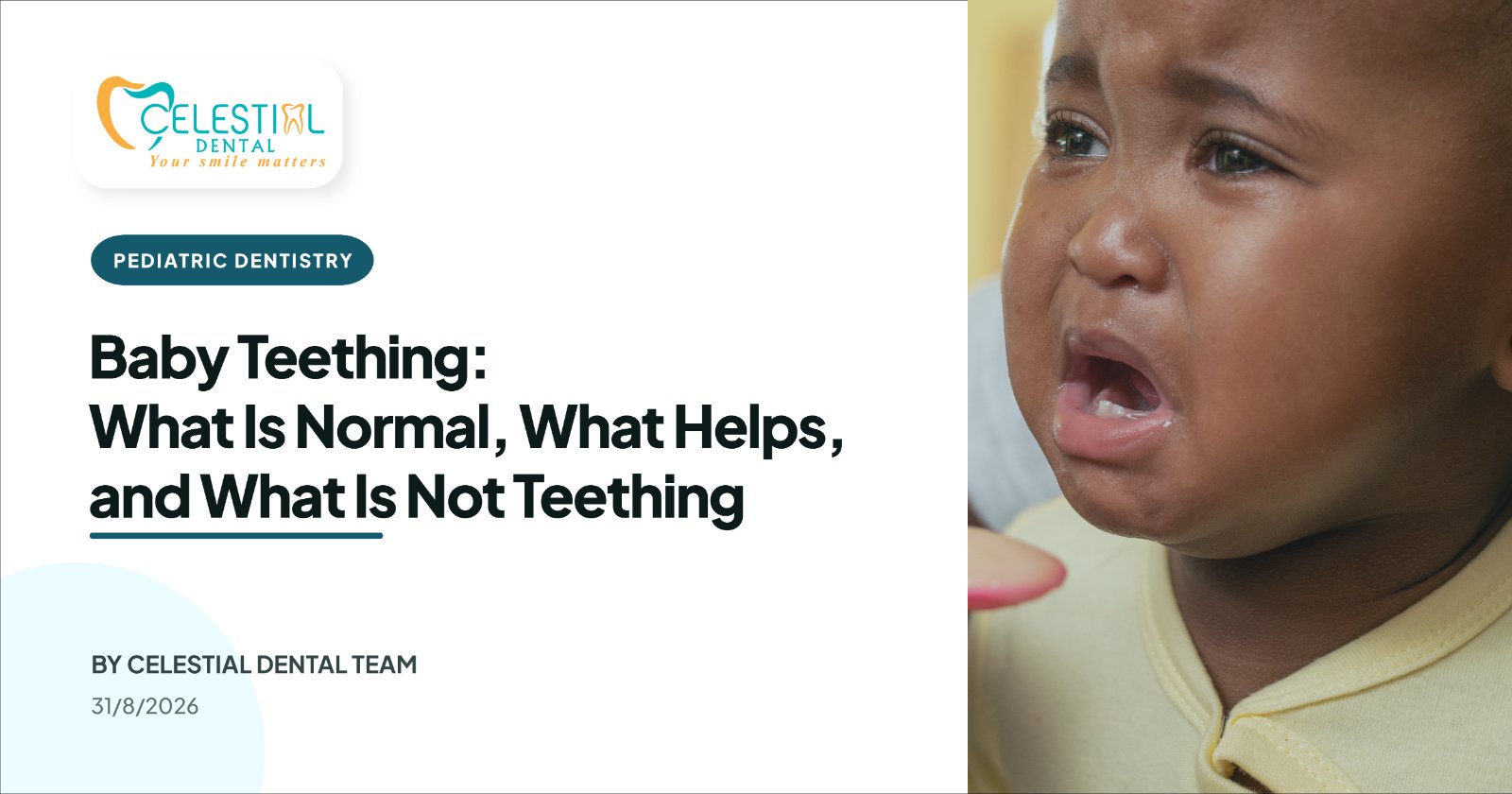
Teething is one of the first things that makes a baby genuinely miserable, and it arrives with a lot of folklore attached. Some of that folklore is harmless. Some of it delays treatment for a sick child, and some of it is dangerous in its own right.
The useful version is short: teething causes local symptoms around the mouth, it is uncomfortable rather than an illness, and there are a few simple things that reliably help.
When do baby teeth come through?
There is a wide normal range, and early or late is usually just variation.
- Around 6 months: the two bottom front teeth, though anywhere from 3 to 12 months is common
- 8 to 12 months: the top front teeth
- 9 to 16 months: the teeth either side of the front ones
- 13 to 19 months: the first molars, at the back
- 16 to 23 months: the canines, the pointed teeth
- 23 to 33 months: the second molars, right at the back
Most children have all 20 baby teeth by about age three. A baby born with a tooth, or one with no teeth at all by 12 to 18 months, is worth mentioning to a dentist, but neither is usually a problem on its own.
The molars are the ones parents remember, because a broad tooth pushing through takes longer and hurts more than a thin front tooth.
What are the real symptoms of teething?
Genuine teething symptoms are local and mild:
- Drooling, sometimes a lot, and a rash on the chin or chest from the wetness rather than from teething itself
- Chewing and gnawing on anything within reach
- Sore, red or swollen gum over the tooth that is coming
- Irritability and disturbed sleep, usually for a few days around each tooth
- Reduced appetite, especially for hard foods, and sometimes more interest in feeding for comfort
- Rubbing the cheek or ear on the same side, because the discomfort refers
- A small bluish swelling over the tooth, called an eruption cyst. It looks alarming and almost always resolves on its own
Symptoms typically last a few days per tooth, not weeks on end.
What is not caused by teething?
This is the most important section, and it is where teething folklore does harm. Teething does not cause:
- High fever. A mild temperature rise can happen, but a fever above 38°C is illness, not teething
- Diarrhoea or vomiting
- A widespread body rash
- A persistent cough or runny nose beyond the mild
- Refusing all feeds, or unusual sleepiness or floppiness
- Convulsions
Babies start teething at roughly the age when the antibodies they got from their mother fade, so they get more infections at exactly the time teeth are arriving. The two coincide, which is why the myth persists. If your baby has a fever, diarrhoea, a rash or seems unwell, have them seen by a doctor and do not put it down to teeth.
In this country that warning carries extra weight. A fever in a baby needs malaria and other serious infection ruled out, and a child with diarrhoea needs watching for dehydration. Every year children are brought to clinics late because a treatable illness was read as teething for several days first. Teeth are never the reason to delay having a sick baby seen.
Is it true that the teeth causing fever should be removed?
No. This needs saying plainly, because the practice is still around and it kills children.
In parts of East Africa, including some communities here, a sick infant with fever, diarrhoea or vomiting is sometimes taken to have the developing canine tooth buds gouged out of the gum, often called nylon teeth, false teeth, or tooth worms. It is done by traditional practitioners, usually on a baby of a few months old, frequently with an unsterilised blade, a nail or a bicycle spoke, and without anaesthetic.
The belief behind it is understandable: the baby is ill, there is a swelling in the gum, and removing the swelling looks like removing the cause. But the swelling is a normal tooth bud, and it is not what made the child sick. What the procedure actually does:
- Leaves the real illness untreated, which is usually malaria, a chest infection or gastroenteritis, and which is what the child was going to be harmed by
- Causes heavy bleeding and severe anaemia in a small baby, sometimes needing transfusion
- Introduces infection, including sepsis and tetanus, through an open wound in a dirty mouth
- Risks transmitting HIV and hepatitis through instruments used on more than one child
- Damages or destroys the permanent canines underneath, leaving lifelong gaps that later need orthodontic or restorative treatment
Health authorities classify this as infant oral mutilation. There is no version of it that is safe, and no dental reason for it at any age.
If your baby is unwell, take them to a doctor. If your baby's gums look swollen and you are worried, bring them to us and we will look, at no risk to the child. And if a tooth bud has already been removed from your child, please still bring them in, without any expectation of a lecture, so we can check the healing and plan for the adult teeth that were affected.
What actually helps?
The things that work are simple and physical.
- Something firm and cool to chew. A solid rubber teething ring chilled in the fridge, never the freezer, since frozen objects can damage the gum
- A clean cold flannel to gnaw on, which many babies prefer to a toy
- Gum pressure. A clean finger rubbed firmly on the gum often settles a baby quickly
- Cold food for babies already on solids: chilled yoghurt, cold cucumber sticks under supervision, or a chilled spoon
- Wipe the drool and use a barrier cream on the chin to prevent a sore rash
- Extra comfort and patience. Broken sleep for a few nights is normal and passes
- Infant paracetamol or ibuprofen at the correct dose for age and weight, if your baby is genuinely distressed. Follow the packet and ask a pharmacist or doctor if unsure
What should I avoid?
Several popular remedies are useless, and a few are unsafe:
- Teething gels containing benzocaine or lidocaine. These carry real risks in infants and have been restricted or withdrawn in several countries. Do not use them without medical advice
- Amber teething necklaces. No evidence of benefit and a genuine strangulation and choking risk. Never leave one on a sleeping baby, and preferably do not use them at all
- Aspirin, in any form, on the gum or by mouth. Aspirin in children is linked to Reye's syndrome
- Rubbing alcohol, whisky or any spirit on the gums
- Teething biscuits and rusks, which are usually sugary and start decay on brand new teeth. A piece of mandazi or a sweet biscuit handed over to quieten a teething baby does the same thing
- Frozen solid objects, which can burn or bruise gum tissue
- Honey, sugar or glycerine rubbed on the gums. It soothes for a minute and coats new teeth in sugar. Honey also should not be given to babies under one year at all
- A sweetened bottle for comfort, especially at night, which is the fastest route to early decay. Sweetened uji, juice or soda in a bottle at bedtime is the single most common cause of the badly decayed front teeth we see in toddlers, because the child falls asleep with the sugar pooled around the upper front teeth and the saliva flow drops overnight. Water only, once the last feed is done
When should I start brushing?
As soon as the first tooth appears, and this catches parents out because it feels early.
- Twice a day, with a smear of fluoride toothpaste the size of a grain of rice for under-threes
- A small soft brush, or a finger brush at first
- Lie the baby on your lap with their head steady, which is easier than trying to brush a standing toddler
- Spit, do not rinse. Even at this age, rinsing washes away the fluoride
- The last brush of the day matters most, and nothing except water afterwards
Before the first tooth, wiping the gums with a clean damp cloth after feeds is a good habit and makes brushing feel normal when it starts.
Decay in baby teeth is not a minor issue, and it moves faster than in adult teeth, which is covered at celestialdental.org/child-cavity-in-baby-tooth-does-it-need-filling.
When should my baby first see a dentist?
By the first birthday, or within six months of the first tooth appearing, whichever comes first. That first visit is mostly a look, a chat about feeding and brushing, and letting your child discover that a dental practice is an ordinary place. The full explanation is at celestialdental.org/when-should-my-child-first-see-a-dentist.
Bring your child in sooner if you see white or brown marks on any tooth, if a tooth looks chipped or discoloured, if the gum is swollen around one tooth, or if your baby has had a knock to the mouth.
What if a tooth comes through in the wrong place?
Baby teeth often arrive crooked, widely spaced or rotated, and most of it sorts itself out. Gaps between baby teeth are a good sign, not a bad one, because the adult teeth that follow are larger and need the room.
Later, when adult teeth start arriving around age six, a common surprise is an adult tooth appearing behind a baby tooth that has not fallen out. That is usually harmless and is explained at celestialdental.org/adult-tooth-growing-behind-baby-tooth-shark-teeth.
Does insurance or SHA cover children's dental visits?
Routine children's examinations and preventive care are among the more commonly covered items, though it depends on your insurer, your scheme, your member category and whether your children are listed as dependants. Celestial Dental accepts SHA for eligible schemes and bills more than 20 private insurers directly, including Jubilee, AAR, Madison, CIC, Britam, APA and Equity Bank Insurance. Send your insurer or SHA scheme name, member category and preferred branch and the team will confirm before you come in. See celestialdental.org/dental-insurance-and-sha-coverage.
Book your baby's first visit
If your baby has their first tooth, that is the moment to book. The visit is short, gentle and mostly about showing you what to do next.
Celestial Dental Centre has child-friendly clinics in Kasarani (Nairobi), Kamakis (Ruiru) and Eldoret, open every day from 07:00 to 20:00.
Call or WhatsApp +254 707 535 000 or book online at celestialdental.org. Tell us your child's age and we will give you a longer, gentler slot.