Celestial Dental Centre › Blog › Pediatric Dentistry
Brown Marks on My Toddler's Front Teeth
By the Celestial Dental Centre clinical team · Published
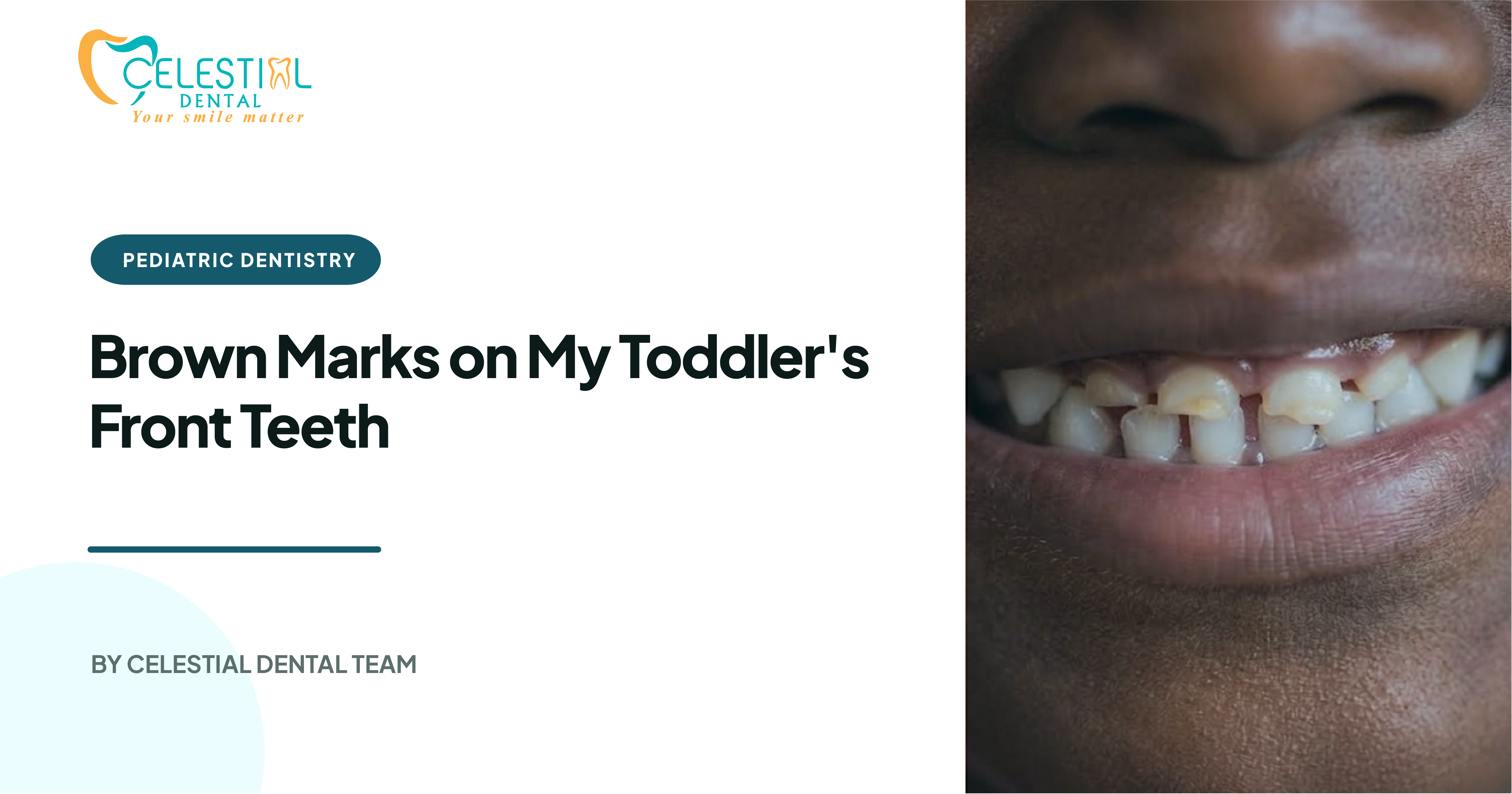
A parent sits down with a two year old on their lap and says some version of the same sentence. His teeth were fine. I only noticed last month. Now look.
And the top front teeth have a dull white band along the gum line, and on one of them the white has gone yellow, and on another there is a brown notch where the edge has started to break away.
This happens fast, it happens in children who are otherwise thriving, and it has a name. Early childhood decay. It is one of the most common conditions we see in small children and one of the most misunderstood.
What are these marks, exactly?
The chalky white band is the first stage. It is not a stain sitting on the tooth, it is the enamel underneath losing its mineral, which changes how it reflects light. Wipe it and it does not come off.
At that stage it is still reversible, which is the single most important thing in this article.
If the process continues, the softened enamel takes up colour from food and turns yellow, then brown. Eventually the surface collapses and a cavity opens up. On upper front teeth, where the enamel is thin, that progression can take months rather than years.
So brown means it has been going on a while. White along the gum line means you have caught it early, and early is a completely different conversation.
Why the top front teeth and not the bottom ones?
This is the detail that usually convinces parents the explanation is right, because it fits what they are seeing.
The bottom front teeth sit right beside the openings of the salivary glands under the tongue. They are bathed in saliva constantly, and saliva washes sugar away and neutralises acid. They are the best protected teeth in the mouth.
The top front teeth have no such protection, and during feeding the tongue lies over the lower teeth and covers them while the upper ones are exposed.
So when sugar sits in a small child's mouth for long stretches, the damage shows up top and front first, in a curve that follows the gum line. If that is the pattern you are looking at, you are looking at early childhood decay rather than at an injury or a developmental mark.
Is it the bottle, the uji, or the juice?
It is less about which food and more about how long it stays in the mouth.
The classic scenario is a bottle at night. A child falls asleep feeding, or wakes and is settled with a bottle, and milk or juice pools around the upper front teeth for hours while saliva flow is at its lowest. That is the single strongest pattern.
Then there is sweetened uji, particularly when it is given slowly over a long period, or sipped on and off through the morning. It is a food we think of as wholesome, and it is, but sugar added to it behaves like sugar in anything else.
Tea with sugar given to a toddler does the same. So does juice or soda in a sippy cup carried around all afternoon. So does a biscuit or sweet from the duka given in small pieces across an hour rather than at one sitting.
The pattern underneath all of it is duration. A sugary drink finished in five minutes at a mealtime does far less harm than the same drink sipped over two hours. The mouth needs time in between to recover, and grazing removes it.
Does this mean I have done something wrong?
No, and I would like to be direct about this because parents carry a lot of guilt into that chair.
Nobody tells you that a bottle at night is different from a bottle at four in the afternoon. Night feeding is normal, exhausting and often the only way anyone gets any sleep. Sweetening uji is what almost everyone does. None of this is neglect and it is not a sign of a dirty home.
It is also not a moral matter for the child. A two year old with decayed front teeth has not been spoiled. They have had a normal childhood diet arranged in a way that happened to suit the bacteria.
What matters now is what changes, not what happened.
Could the white marks be something else?
Yes, and this is worth ruling out, because in Kenya there is a second common cause of white marks on children's teeth and its treatment is entirely different.
Fluorosis, from high natural fluoride in borehole water in parts of the country, also produces white marks. But fluorosis is usually symmetrical, affects several teeth in the same way, appears on the tooth surface generally rather than hugging the gum line, and does not soften the tooth.
Decay is asymmetrical, worse on some teeth than others, follows the gum margin and progresses if nothing changes. Fluorosis largely stays as it is.
There is a full explanation at celestialdental.org/dental-fluorosis-kenya-brown-stains-treatment-options. If you are unsure which you are looking at, that is a two minute question at an examination.
Can I just stop the sugar and will the marks go away?
Partly, and this is the good news in an article that has been mostly bad news.
At the white stage, enamel can take mineral back up. Reducing how often sugar appears, cutting out the night bottle, and getting fluoride onto those teeth twice a day can arrest the process and sometimes harden the marks back into something stable. They may not vanish cosmetically, but they stop advancing.
Brown, broken enamel does not regrow. That needs treating.
The practical changes that do the most work are these. Feeding finishes before sleep rather than during it, and if something is needed at night, plain water. Sugary drinks at mealtimes rather than carried around. Brushing twice a day with a smear of fluoride toothpaste appropriate for their age, and after the last feed, not before it.
What will a dentist do to a child this small?
Less than parents fear, most of the time.
The first visit is usually looking, lifting the lip, and talking. For early white marks the treatment may be nothing more than a fluoride varnish painted on, which takes seconds and needs no injection, plus a plan for what changes at home and a review to see whether it has held.
Where there is an actual cavity, the options depend on the child, the tooth and how far it has gone. Some are restored, some are sealed and monitored, and some badly broken front teeth do need removing. Losing an upper front baby tooth early is not the disaster it sounds, because the adult tooth is years away and speech and eating adapt.
What we try hard to avoid is a first dental experience that frightens a child, because that lasts longer than the tooth does. How that decision gets made in more detail is at celestialdental.org/child-cavity-in-baby-tooth-does-it-need-filling.
Will their adult teeth be affected too?
The decay itself does not transfer. The adult teeth are separate and are forming in the bone.
Two things do carry over though. The bacteria and the habits are the same, so a child who has had early decay is at higher risk in their adult teeth unless something changes. And a severe infection in a baby tooth can occasionally affect the adult tooth developing underneath it, which is one of the reasons we do not simply wait for baby teeth to fall out.
So treat this as early warning rather than as a self-correcting phase.
How do I brush a child who fights me?
Expect resistance and stop treating it as a battle you have to win through persuasion.
Lay them back, head in your lap, so you can see. Brush from behind rather than facing them. Be quick and thorough rather than gentle and vague. Sing, count, do the same order every time so it is predictable.
If they will only tolerate one proper brushing a day, make it the one before bed, and let the morning one be whatever you can manage. The night one matters more.
Does insurance or SHA cover children's treatment?
Examinations, X-rays and diagnosis are the categories most commonly covered, and fillings and extractions are usually assessed as treatment of disease, though cover varies by insurer, scheme and member category, and depends on whether the child is listed as a dependant. Confirm your child's status before the appointment rather than at the desk.
Celestial Dental accepts SHA for eligible schemes and bills more than 20 private insurers directly, including Jubilee, AAR, Madison, CIC, Britam, APA and Equity Bank Insurance. Ask for a written estimate covering the whole plan before treatment begins.
Book an appointment
Call or WhatsApp +254 707 535 000, or book online at celestialdental.org. Clinics in Kasarani (Nairobi), Kamakis (Ruiru) and Eldoret, open every day from 07:00 to 20:00.
If the marks are still white, come now rather than waiting to see whether they get worse. That is the stage where the least needs doing.