Celestial Dental Centre › Blog › Gum Health
Diabetes and Gum Disease: Why They Feed Each Other
By the Celestial Dental Centre clinical team · Published · Updated
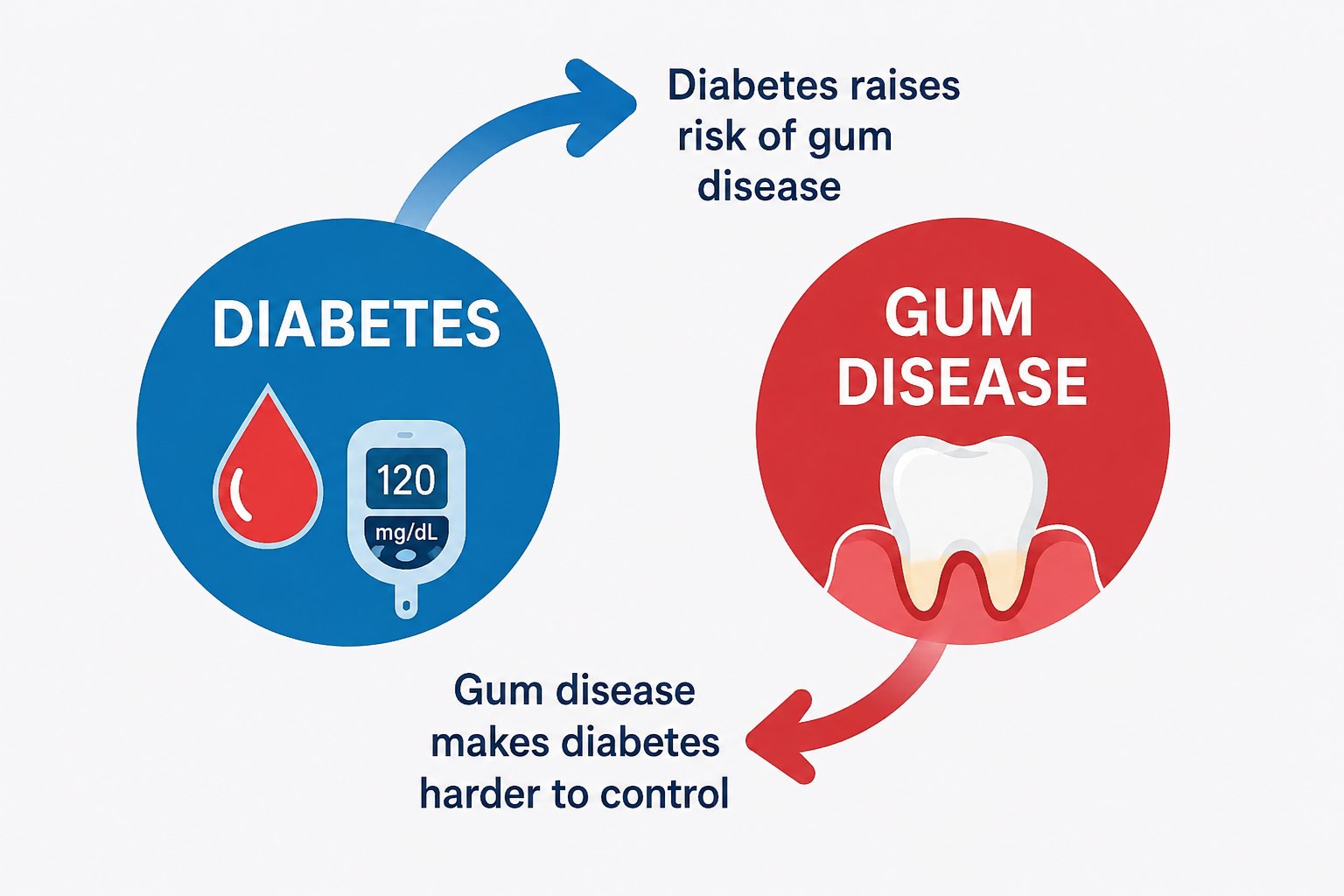
If you have diabetes, your gums are part of your diabetes care, and most people are never told this. Gum disease is more common in people with diabetes, it progresses faster, and it responds less well to treatment when blood sugar is high.
What surprises people more is the other direction. Long-standing gum infection makes blood sugar harder to control. Treating the gums can improve control measurably. So this is not a footnote to your diabetes, it is part of managing it.
Why does diabetes affect my gums?
Raised blood sugar changes the mouth in several ways at once, and they compound.
- Wound healing slows. The gums are constantly repairing themselves against everyday bacteria, and that repair happens more slowly
- The immune response weakens. The white cells that keep gum bacteria in check work less efficiently, so a small inflammation becomes an established infection
- Blood vessels thicken, so oxygen and nutrients reach the gum tissue less easily and waste leaves more slowly
- Saliva flow drops and sugar levels in saliva rise, which favours the bacteria that cause decay and gum inflammation. Dry mouth in its own right is covered at celestialdental.org/dry-mouth-causes-risks-and-what-helps
- Bone loss accelerates. Gum disease destroys the bone that holds teeth in, and diabetes speeds that up
The result is that the same plaque that would cause mild gum inflammation in someone else causes faster, deeper damage.
Does gum disease really affect my blood sugar?
Yes, and this is the part worth taking seriously. Advanced gum disease is a chronic bacterial infection with an inflamed surface area that is larger than people imagine. Chronic inflammation anywhere in the body raises insulin resistance, which pushes blood sugar up.
The practical consequence is that someone doing everything right with diet, medication and exercise can still struggle for control while an untreated gum infection sits in the background. Treating that infection, with proper cleaning below the gumline and follow-up, often improves control. It is one of the few dental treatments with a measurable general-health payoff.
Tell your dentist you have diabetes, and tell your doctor about your gums. These two conversations rarely happen, and they should.
What are the warning signs?
Gum disease is painless until late, which is why it is missed. Watch for:
- Bleeding when you brush or floss. Never normal, at any age. See celestialdental.org/bleeding-when-brushing-teeth-causes-and-what-to-do
- Red, swollen or tender gums, rather than firm and pale pink
- Persistent bad breath or a bad taste that returns quickly after brushing, covered at celestialdental.org/bad-breath-even-after-brushing-causes-and-fixes
- Gums pulling away from the teeth, making teeth look longer, see celestialdental.org/receding-gums-causes-and-can-they-grow-back
- Teeth that feel loose or have shifted, or a bite that feels different, see celestialdental.org/adult-tooth-feels-loose-can-it-be-saved
- Pus at the gumline, or repeated gum abscesses
- Slow healing after any dental work
If you have diabetes and any of these, do not wait for your next routine visit.
What else does diabetes do in the mouth?
Beyond the gums, several things are more common and worth naming so they are not ignored:
- Dry mouth, which raises decay risk sharply because saliva is the mouth's main defence
- Oral thrush, a fungal infection showing as white patches or soreness, more likely with high sugar levels, dentures or antibiotics
- Burning mouth or altered taste
- More decay, particularly at the gumline and on root surfaces where the gums have receded
- Slower healing after extractions, which is why your dentist may plan differently, and why aftercare matters more. See celestialdental.org/tooth-extraction-aftercare-how-to-heal-fast
- Mouth ulcers that take longer to settle. Any ulcer lasting more than three weeks needs checking, see celestialdental.org/mouth-ulcer-that-wont-heal-causes-and-when-to-worry
What should I do differently at home?
The routine is the standard one, done more consistently, because the margin for error is smaller.
- Brush twice daily with fluoride toothpaste, including along the gumline at a slight angle, for a full two minutes
- Clean between the teeth every day. This is where gum disease starts and a brush does not reach. Which tool suits your gaps is covered at celestialdental.org/flossing-tight-teeth-floss-interdental-brush-or-water-flosser
- Keep blood sugar as close to target as you can. Gum treatment works better when control is better, and vice versa
- Drink water often and treat dry mouth rather than living with it
- Do not smoke. Smoking and diabetes together multiply gum disease risk rather than simply adding to it
- Check your mouth monthly in good light for bleeding, swelling or ulcers
- If you wear dentures, take them out at night and clean them daily, since thrush is more likely
How often should I see a dentist?
More often than the standard six months for most people with diabetes. Every three to four months is common where there is gum disease or where control fluctuates, because the cleaning has to stay ahead of the infection rather than catch up with it.
Come in sooner if your gums bleed persistently, if control has recently worsened, or if you are due for any procedure where healing matters.
When you book, say that you have diabetes. It changes how the appointment is planned: timing around meals and medication, longer healing expectations, and closer monitoring of the gums.
Why does this matter particularly in Kenya?
Because of who finds out, and when.
Diabetes is rising quickly here, and a significant share of people living with it have not yet been diagnosed. That produces a pattern we see in the chair more often than people would guess: an adult comes in with a gum abscess that keeps returning, or gum disease that is moving far faster than their age and their brushing would explain, or an extraction site that simply will not heal, or repeated oral thrush. Sometimes the right next step is not another course of antibiotics, it is a blood sugar test. We do refer patients to have that checked, and for some of them the dental visit is where the diagnosis starts.
The second pattern is about care that runs on separate tracks. Plenty of our patients attend a diabetes clinic faithfully, carry the clinic booklet, take the medication and watch the diet, and have never once been asked about their gums, in either direction. Nobody at the diabetes clinic mentions teeth, and nobody at the dentist asks about sugar control. The two halves never meet, and the gum infection quietly makes the control worse the entire time.
You can close that gap yourself in one sentence at each place. Tell us you have diabetes. Tell your diabetes clinic you are being treated for your gums. Bring your clinic booklet when you come to us, because it usually has your recent results and medication in it and saves everyone guessing.
The third thing is sugar, and specifically how it is taken rather than how much. Sweet chai several times a day, and soda through the afternoon, is a harder problem for both your gums and your blood sugar than the same sugar taken once with a meal, because it keeps both under constant load. Cutting the number of separate sugar events is usually easier to sustain than trying to cut it all out, and it helps both conditions at once.
What does treatment involve?
For gum disease the foundation is thorough cleaning below the gumline, sometimes called scaling and root planing, which removes the hardened deposits that brushing cannot reach. It is usually done with local anaesthetic over one or more visits, followed by a review to check the gums have responded. Whether cleaning damages teeth, the usual worry, is answered at celestialdental.org/is-teeth-scaling-and-polishing-bad-for-your-teeth.
After that, maintenance is the whole game: regular professional cleaning at a shorter interval, and daily cleaning between the teeth at home. Gum disease is controlled rather than cured, and bone that has been lost does not grow back on its own.
Where teeth have already been lost, replacement options are covered at celestialdental.org/missing-tooth-implant-bridge-denture-or-crown. Implants can work well in people with diabetes, but good blood sugar control and healthy gums are prerequisites rather than details, so expect that conversation.
What should I tell my dentist?
Bring the specifics, because they change the plan:
- That you have diabetes, which type, and how long
- Your clinic booklet, which is the simplest way to bring all of this at once
- Your most recent HbA1c if you know it
- All medications, including insulin, metformin and anything for blood pressure or cholesterol
- Whether you have had hypos, and what you usually do about them
- Any other conditions, especially kidney or heart disease
- When you last ate, on the day of the appointment
Practical tips that make visits easier: book a morning appointment after eating and taking your usual medication, bring a fast-acting sugar source with you, and do not skip a meal because of a dental visit.
Does insurance or SHA cover gum treatment?
Gum disease treatment sits on the medically necessary side rather than the cosmetic side, so it is more commonly covered than elective work, though cover varies by insurer, scheme and member category and deeper treatment may need pre-authorisation. Celestial Dental accepts SHA for eligible schemes and bills more than 20 private insurers directly, including Jubilee, AAR, Madison, CIC, Britam, APA and Equity Bank Insurance. Send your insurer or SHA scheme name, member category and preferred branch and the team will confirm before the visit. See celestialdental.org/dental-insurance-and-sha-coverage.
Book a gum assessment
If you have diabetes and your gums bleed, or it has been more than six months since a proper cleaning, book an assessment. Treating the gums is one of the few things that helps your mouth and your blood sugar at the same time.
Celestial Dental Centre has clinics in Kasarani (Nairobi), Kamakis (Ruiru) and Eldoret, open every day from 07:00 to 20:00.
Call or WhatsApp +254 707 535 000 or book online at celestialdental.org. Mention that you have diabetes when you book so we can plan the appointment around your medication and meals.