Celestial Dental Centre › Blog › General Dentistry
Sharp Pain When I Bite, But Nothing Shows Up
By the Celestial Dental Centre clinical team · Published
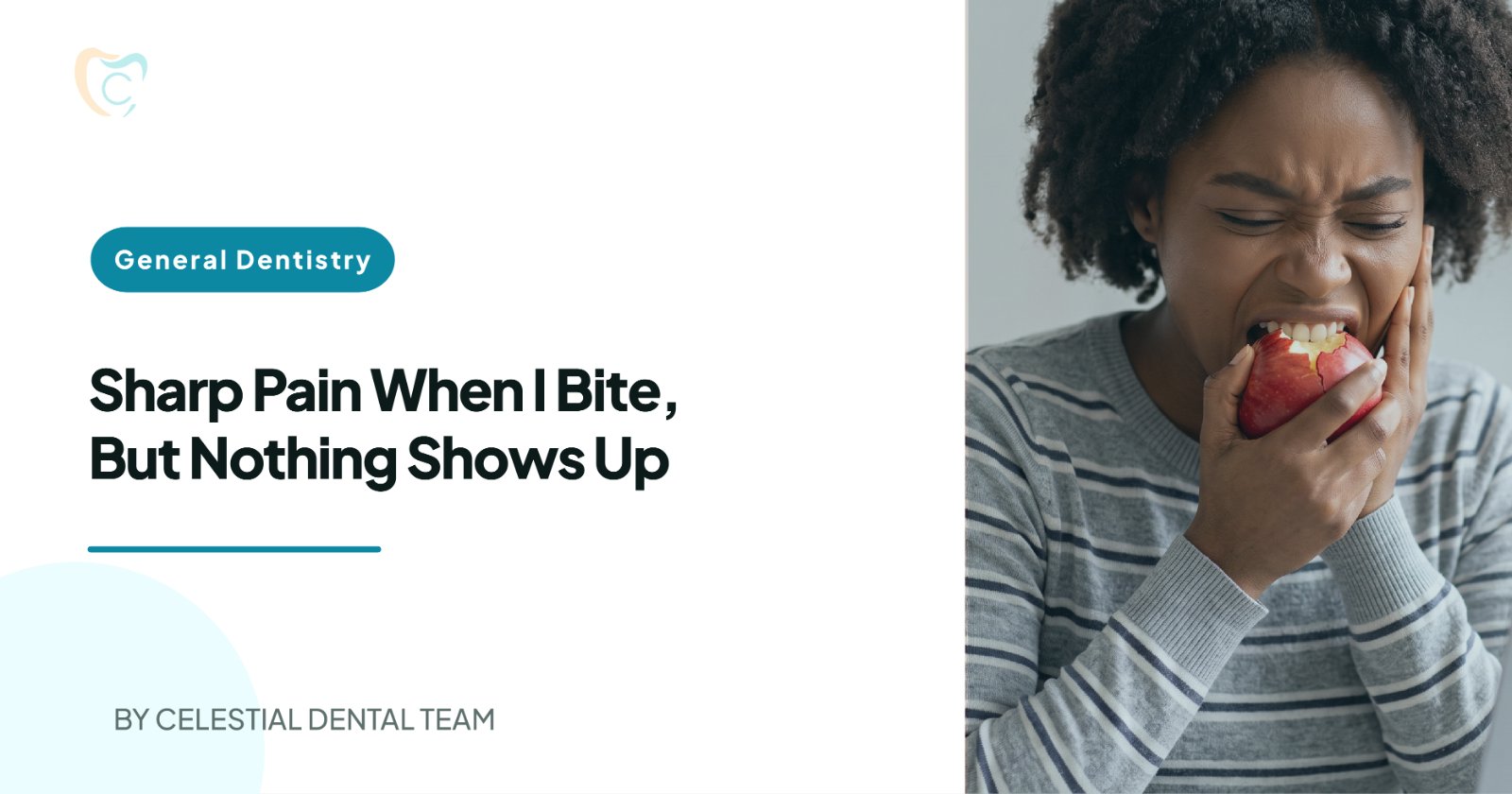
There is a particular kind of dental problem that makes people feel they are imagining things. A sharp jolt when you bite on something, gone the instant you let go. Nothing to see. Nothing on the X-ray. Sometimes a dentist finds nothing at all and you leave wondering whether you invented it.
You did not. That specific pattern, pain on release of biting pressure, is close to a signature, and what it usually means is that the tooth is cracked.
Why does the pain come and go?
Because a crack behaves like a hinge, and it only hurts when it moves.
A cracked tooth is not split in two. It has a fracture line running through it that is held closed by the surrounding tooth structure. When you bite on the right spot at the right angle, the two halves flex apart by a fraction of a millimetre. That movement disturbs the living tissue inside the tooth, and you get a sharp jolt. Release the pressure, the halves close, and the pain stops immediately.
That is why the pain is unpredictable. It depends on the exact food, the exact angle, the exact cusp you loaded. You can chew normally for a week and then catch it on a grain of rice and nearly come out of the chair.
The classic description is pain on releasing the bite rather than on clenching, and if that matches what you feel, say exactly that to your dentist. It is one of the most useful sentences a patient can offer.
Why does nothing show on the X-ray?
This is the part that frustrates everyone, and it is worth understanding because it is a limitation of physics rather than of care.
An X-ray is a shadow picture. It shows differences in density, and it captures them in one plane. A crack running front to back through a tooth, with the two halves still touching, presents almost no gap for the X-ray to pass through differently. It is like photographing a closed door and trying to see the join.
Cracks that do show up are usually the ones that have already gone too far, or that have spread wide enough to let infection into the bone at the root tip. What X-rays are genuinely good for, and how often they are needed, is covered at celestialdental.org/are-dental-x-rays-safe-and-how-often-do-i-need-them.
So a normal X-ray does not rule out a crack. It rules out most of the other things.
How is a crack actually found?
By provoking it deliberately, in a controlled way, and by looking properly. A dentist hunting a crack will typically:
- Ask you to bite on a small plastic wedge, one cusp at a time. When the painful cusp is loaded and then released, you will know instantly. This single test finds most of them and costs nothing
- Remove the existing filling, if there is one, because cracks very often run underneath and are invisible until the filling is out
- Use magnification and a strong light, sometimes shining light through the tooth so a crack casts a shadow
- Apply a dye that seeps into the fracture line and makes it visible
- Test the nerve with cold, to work out whether the pulp is still healthy or already dying
- Check your bite, since a tooth taking more force than its neighbours is the one that cracks
- Ask about your history, which is often the clincher
Expect this to take more than a two-minute look. A crack hunt is a proper appointment. If a tooth has been troubling you for months across more than one visit, say so at the start, because that history changes what we look for.
What causes teeth to crack?
Some of it is bad luck. Most of it is force, repeated over years or delivered in one moment.
- Biting something hard. In this country the repeat offenders are bones in nyama choma, mahindi choma eaten straight off the cob, sugarcane, kashata and groundnuts, and the stone that turns up in a plate of githeri or beans. Bottle tops and ice belong on the same list
- A large old filling. The bigger the filling, the less tooth is left to resist flexing, and the walls around it become the weak point. This is the single most common setting for a cracked tooth
- Grinding and clenching, which load teeth for hours a night with forces far beyond chewing, see celestialdental.org/teeth-grinding-and-jaw-pain-causes-and-treatment
- A heavy bite on one tooth, where a filling or crown sits slightly high, or where teeth are missing elsewhere and the remaining ones carry the whole load, see celestialdental.org/missing-tooth-implant-bridge-denture-or-crown
- A knock to the mouth, from sport, a fall or a road accident
- Sudden temperature swings, such as very hot tea followed immediately by cold water
- Age. Teeth become less elastic over decades, and cracks accumulate
Notice how many of these are chronic rather than dramatic. Most people cannot name the moment it happened, and that is normal.
What are the warning signs?
Beyond the biting jolt, the pattern usually includes some of these:
- Sharp pain on release of biting pressure, especially on hard or fibrous food
- Sensitivity to cold, and sometimes to sweet, that is sharper on one specific tooth
- Pain that you cannot localise. People frequently point to the wrong tooth, or say only that it is "somewhere on the lower right"
- Discomfort that comes and goes for weeks or months without ever settling for good
- A tooth that feels different when you run your tongue over it, or a rough edge that appears
- No swelling and no constant ache, at least at first
The situation changes if the pain becomes constant, throbs, wakes you at night, or is joined by swelling. That means the crack has let bacteria into the nerve and the tooth is now infected, which is a different and more urgent problem. Throbbing that worsens lying down is explained at celestialdental.org/why-toothache-gets-worse-at-night, and any facial or gum swelling should be seen the same day, see celestialdental.org/dental-abscess-swollen-gum-or-face-what-to-do.
Is this the same as a chipped tooth?
No, and the difference matters for how urgently you act.
A chip is missing tooth. You can see it, feel it with your tongue, and it is usually a cosmetic or comfort problem that can wait for a normal appointment. Those options are set out at celestialdental.org/chipped-broken-tooth-repair-options.
A crack is a fracture line inside a tooth that still looks whole. There is nothing to see, and it is the more serious of the two, because it is progressive. Cracks travel. A crack confined to the enamel and dentine today can reach the pulp in a few months, and once it extends below the level of the bone the tooth usually cannot be saved at all.
That is the whole argument for not waiting. The cost of investigating a crack early is one appointment. The cost of ignoring it can be the tooth.
How is a cracked tooth treated?
It depends entirely on how far the crack has travelled, which is why diagnosis comes first.
- A crown, or an onlay that covers the cusps. This is the mainstay. Wrapping the tooth holds the segments together so they can no longer flex, which stops the pain and stops the crack spreading. A filling usually will not do this, because a filling sits inside the tooth and does not bind the walls, see celestialdental.org/do-i-need-a-dental-crown-signs-types-and-how-long-they-last
- A temporary band or a provisional crown first, in some cases, to confirm that splinting the tooth actually removes the pain before committing to the final restoration
- Root canal treatment, then a crown, where the crack has reached the nerve or the nerve has already died. What that involves is at celestialdental.org/does-a-root-canal-hurt-how-long-does-it-take
- Extraction, where the crack runs vertically down the root or splits the tooth below the bone. This is the outcome we are trying to avoid by catching it early, and the replacement options are at celestialdental.org/missing-tooth-implant-bridge-denture-or-crown
- Adjusting the bite, often alongside the above, to take excess force off that tooth
- A night guard, if grinding is part of the cause, to protect both the repaired tooth and the others
An honest caveat: cracks do not heal, and no treatment makes the fracture line disappear. Treatment stops the movement and protects the tooth. Occasionally a tooth continues to hurt after a crown and turns out to need root canal treatment afterwards, and that is not a failure of the crown, it is the crack having been deeper than anyone could see.
What can I do in the meantime?
While you wait for the appointment, the aim is to stop the tooth flexing.
- Chew on the other side. This is the most effective thing you can do
- Avoid hard and fibrous food entirely on that side, especially bones, maize, sugarcane and nuts
- Avoid extremes of temperature, particularly very cold drinks
- Do not test it repeatedly. People poke at the painful tooth to see whether it still hurts, and every test drives the crack a little further
- Take ordinary painkillers as directed on the packet if needed
- Wear your night guard if you have one
Do not wait for it to settle on its own. A crack that stops hurting has often stopped because the nerve inside has died, not because the tooth has recovered.
Does insurance or SHA cover treating a cracked tooth?
Partly, and the expensive part usually is not. Diagnosis, X-rays and root canal treatment are treatment of disease rather than cosmetic work, so they sit among the more commonly covered items. Crowns are not covered, and you should plan for a crown as a cost you will meet yourself.
That matters more here than in most situations, because a cracked tooth very often needs a crown rather than a filling. Covering the tooth is what stops the segments flexing, so it is usually the treatment, not an upgrade. Ask for the whole plan and a written estimate at the first visit rather than approving it in stages, so the crown is not a surprise after the root canal treatment has already been done.
Celestial Dental accepts SHA for eligible schemes and bills more than 20 private insurers directly, including Jubilee, AAR, Madison, CIC, Britam, APA and Equity Bank Insurance. Send your insurer or SHA scheme name, member category and preferred branch and the team will confirm before treatment starts. See celestialdental.org/dental-insurance-and-sha-coverage.
Book an appointment for a tooth that hurts on biting
If you get a jolt on biting and nothing has ever been found, come and have it hunted properly. Bring the history, including how long it has been going on and what you were eating when you first noticed it.
Celestial Dental Centre has clinics in Kasarani (Nairobi), Kamakis (Ruiru) and Eldoret, open every day from 07:00 to 20:00.
Call or WhatsApp +254 707 535 000 or book online at celestialdental.org. Tell us it is pain on biting rather than a general toothache, and say if it hurts more when you let go than when you press down, because that one detail tells us what to test.