Celestial Dental Centre › Blog › Gum Health
Smoking, Shisha and Vaping: What They Do to Your Teeth and Gums
By the Celestial Dental Centre clinical team · Published · Updated
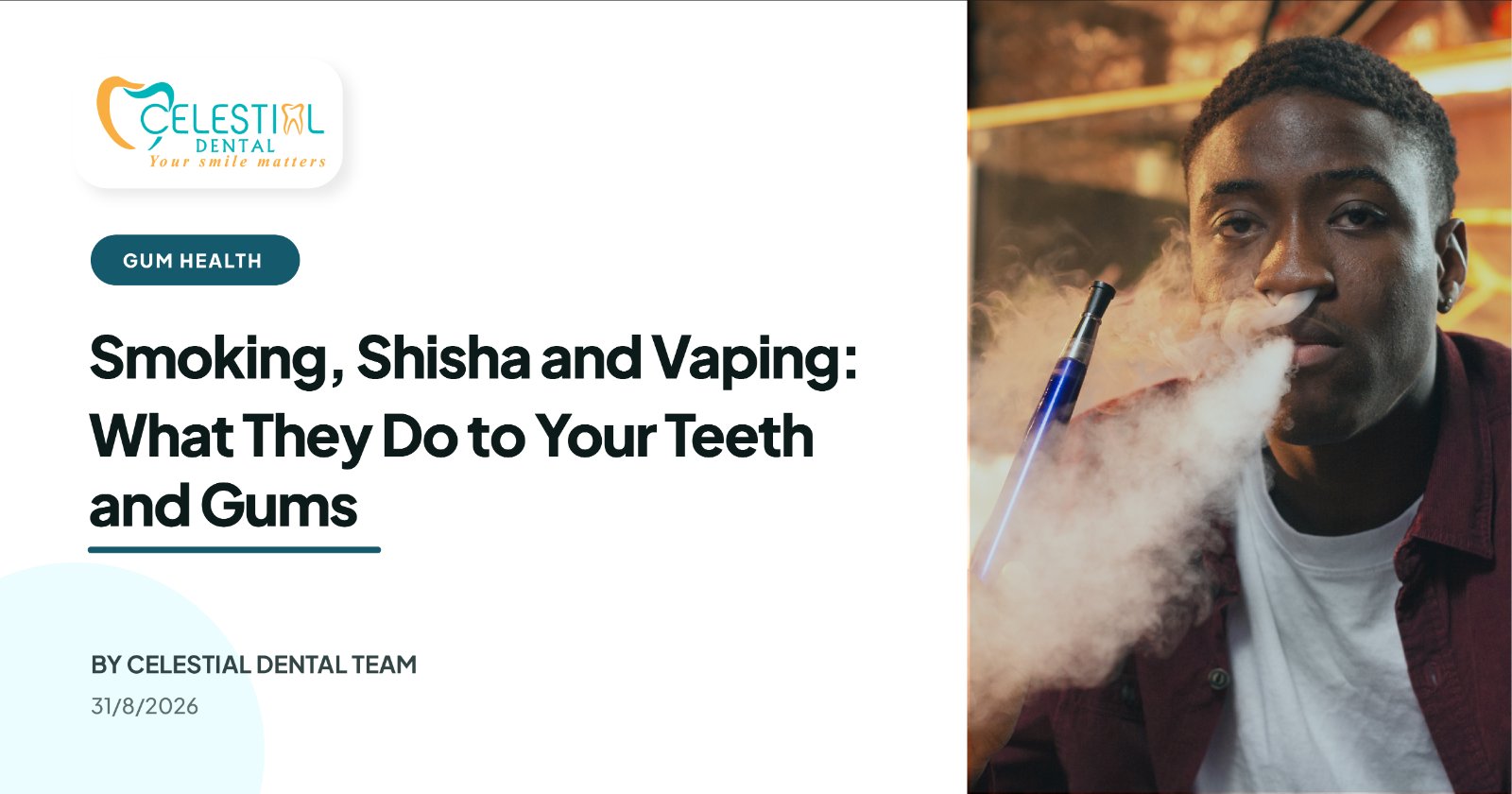
Most people who smoke know it stains their teeth. Far fewer know that smoking is the strongest modifiable risk factor for losing them, or that it hides the earliest warning sign while the damage is happening.
That second part matters more than the staining. It is the reason smokers often arrive at a dental practice with advanced gum disease and no idea anything was wrong.
How does smoking damage my gums?
Nicotine narrows the small blood vessels in the gums, which reduces the blood supply to the tissue that is supposed to be fighting infection. The immune cells in the gums work less effectively, and healing slows.
The consequence is a quiet, faster-moving version of gum disease:
- Deeper pockets form between gum and tooth, where bacteria live beyond the reach of a toothbrush
- Bone loss is faster, and bone does not grow back on its own, see celestialdental.org/receding-gums-causes-and-can-they-grow-back
- Teeth loosen and are eventually lost, see celestialdental.org/adult-tooth-feels-loose-can-it-be-saved
- Treatment works less well. Gum treatment in someone who smokes produces a smaller improvement than the identical treatment in someone who does not
And the cruel part: smoking suppresses bleeding. Bleeding gums are the body's early alarm for gum disease, and constricted vessels mean smokers often do not bleed even when the disease is advanced. The absence of blood gets read as health. It is the opposite. What bleeding gums normally mean is at celestialdental.org/bleeding-gums-causes-treatment-and-when-to-see-a-dentist.
What else does it do in the mouth?
- Staining. Tar and nicotine produce brown and yellow discolouration that ordinary brushing does not remove, and it settles into the roughened surface of tartar
- Bad breath that returns quickly whatever you do about it, see celestialdental.org/bad-breath-even-after-brushing-causes-and-fixes
- A dulled sense of taste and smell, which usually recovers within weeks of stopping
- More tartar, because smoking changes the mouth environment
- Dry mouth, which raises decay risk, see celestialdental.org/dry-mouth-causes-risks-and-what-helps
- Slower healing after extractions, and a much higher risk of dry socket. That is the painful complication where the clot is lost from the socket, covered at celestialdental.org/dry-socket-after-tooth-extraction-signs-and-what-to-do
- Higher implant failure rates, because implants depend on bone healing around them
- White patches, red patches or ulcers that do not heal, which need urgent assessment
Is shisha safer than cigarettes?
No, and this is the most common misconception we hear.
A shisha session typically lasts far longer than a cigarette, and the volume of smoke inhaled over that session is very much larger. The water does not filter out the harmful constituents in any meaningful way. On top of the tobacco smoke, the charcoal used to heat it produces its own carbon monoxide and other combustion products.
There is also a sharing dimension: a mouthpiece passed around a group is a route for transmitting oral and respiratory infections, including herpes simplex.
For your mouth specifically, shisha carries the same gum disease, staining, dry mouth, delayed healing and oral cancer risks as cigarettes. Social and occasional does not mean harmless.
There is a specifically Kenyan wrinkle here. Shisha has been banned in this country since 2017, covering importation, manufacture, sale and use, and yet it is still smoked in plenty of places. What the ban changes for you as a patient is that what is in the bowl is now entirely unregulated. Nobody is checking the tobacco, the flavouring or the charcoal, the equipment is often shared and rarely properly cleaned, and there is no labelling of any kind. So the honest position is that the health picture is at least as bad as the one described above, and possibly worse, because nobody knows what is actually in it.
We are not the enforcement authority and we are not interested in that side of it. Tell the dentist if you use shisha, in the same way you would mention a medication, so that the examination looks properly at your gums and soft tissues. Nobody at Celestial is going to report you or lecture you about it.
What about vaping?
Vaping avoids combustion, which removes tar and many of the products of burning. That is a genuine difference, and for someone switching completely from cigarettes it is generally considered less harmful overall.
Less harmful is not harmless, and the mouth is where several of the remaining effects land:
- Nicotine still constricts blood vessels, so the gum blood supply issue does not go away, and nicotine is the addictive part regardless of delivery
- Dry mouth is common, because propylene glycol draws moisture, and dry mouth means more decay
- Gum inflammation and irritation of the mouth lining are reported
- Sweetened liquids bathe the teeth in flavourings, and decay has been reported in people who vape heavily
- Long-term effects are genuinely not yet known. These products have not been in wide use long enough for the multi-decade data we have on cigarettes
If vaping is a step on the way to stopping nicotine altogether, that is a reasonable use of it. As a permanent substitute, it is not a clean bill of health for your gums.
What about kuber, ugoro and nicotine pouches?
Smokeless does not mean safe, and this is the group most often left out of the conversation.
Chewed tobacco, snuff and similar products hold tobacco directly against one patch of gum and cheek for long periods, which concentrates the exposure in a way a cigarette does not. What we see in the chair is fairly consistent: recession exactly where the product is parked, a leathery white or wrinkled patch of lining at that spot, heavy staining, and in the worst cases a change in the tissue that needs a biopsy rather than reassurance.
- Kuber is chewed and held in the sulcus, usually in the same place every time. It is potent, it is addictive, and the site where it sits is the site that develops the lesion
- Ugoro, taken as snuff, still delivers nicotine and still affects the gum blood supply, so the gum disease picture applies even without a chewing habit
- Nicotine pouches, the newer white pouches placed under the lip, contain no tobacco leaf but do hold concentrated nicotine against one spot of gum. Gum irritation and recession at the placement site are the common findings, and the addiction is unchanged
If you use any of these, move the placement site around rather than using the same spot daily, and get the area looked at properly at least once a year.
What about miraa and muguka?
Chewing khat is common enough here that leaving it out would be dishonest, and it has real effects on the mouth even though it is not tobacco.
- Staining and a heavy brown deposit on the teeth on the chewing side, which no amount of home brushing shifts
- Gum recession and keratosis on the side habitually used, from hours of mechanical pressure in one place
- Marked dry mouth, both from the chewing and from the drinks that usually accompany it, and dry mouth drives decay, see celestialdental.org/dry-mouth-causes-risks-and-what-helps
- Long sessions with sugary sodas or sweet chai, which is a bigger decay risk than the leaf itself
- Temporomandibular joint and muscle pain from sustained one-sided chewing, see celestialdental.org/teeth-grinding-and-jaw-pain-causes-and-treatment
- Frequent combination with cigarettes or tobacco, which is where the serious cancer risk enters
The practical advice is not usually to stop. It is to alternate the chewing side, drink water rather than soda during a session, and have the soft tissues on the chewing side examined properly rather than assuming a white patch is just from the leaves.
How serious is the mouth cancer risk?
This is the reason your dentist looks at your tongue, the floor of your mouth and the inside of your cheeks at a check-up, not just your teeth. Tobacco in every form is the leading risk factor for oral cancer, and alcohol multiplies rather than adds to that risk when the two are combined.
Signs to take seriously, particularly if you use tobacco:
- An ulcer that has not healed in three weeks, see celestialdental.org/mouth-ulcer-that-wont-heal-causes-and-when-to-worry
- A white or red patch anywhere in the mouth that will not rub off
- A lump or thickening in the cheek, tongue, lip or neck
- Persistent hoarseness, or difficulty or pain on swallowing
- Numbness of the lip or tongue
- A tooth that becomes loose with no obvious dental cause
- Bleeding in the mouth with no clear source
Found early, outcomes are dramatically better. Do not wait to see whether it settles.
What improves if I stop?
The recovery is faster than most people expect.
- Within days: taste and smell start returning
- Within weeks: blood flow to the gums improves, and gums may start bleeding again. That is not the disease getting worse, it is your early warning system switching back on
- Within months: gum treatment starts working properly again, and healing after procedures normalises
- Over years: oral cancer risk falls steadily toward that of someone who never smoked
Stopping does not reverse bone that has already been lost, but it stops the loss and makes everything else treatable. It is the single most valuable thing you can do for your teeth, ahead of any product or procedure.
What can I do in the meantime?
If you are not ready to stop, or you are working on it:
- Brush twice daily with fluoride toothpaste and clean between the teeth every day
- Professional cleaning more often, often every three to four months rather than six, because tartar builds faster
- Do not rely on absence of bleeding as a sign your gums are fine
- Have your mouth screened at every check-up, and say that you smoke or use shisha so the examination is done with that in mind
- Never smoke after an extraction. At minimum avoid it for the first 72 hours, since smoking is the main cause of dry socket
- Drink water frequently for dry mouth, and avoid sugary drinks as the remedy
- Ask about stopping support. Your dentist can point you in the right direction, and there is no lecture involved
On staining: a professional scale and polish removes surface stain, and it is the effective option. Whitening is discussed at celestialdental.org/teeth-whitening-in-kenya-how-it-works-safety-and-results, and the home methods people try first are examined at celestialdental.org/do-charcoal-baking-soda-and-salt-whiten-teeth. Whitening while continuing to smoke gives a short-lived result, and no whitening treatment addresses the gum damage underneath.
Does insurance or SHA cover gum treatment and cleaning?
Cleaning and gum disease treatment are preventive and medically necessary care, so they are among the more commonly covered items, subject to your insurer, scheme and member category, and deeper treatment may need pre-authorisation. Cosmetic work such as whitening is normally excluded and paid privately. Celestial Dental accepts SHA for eligible schemes and bills more than 20 private insurers directly, including Jubilee, AAR, Madison, CIC, Britam, APA and Equity Bank Insurance. Send your details and the team will confirm before your visit. See celestialdental.org/dental-insurance-and-sha-coverage.
Book a gum and mouth check
If you smoke or use shisha, an examination should include a proper look at your gums and the soft tissues, not just your teeth. If you have a patch, lump or ulcer that has been there more than three weeks, come in now rather than watching it.
Celestial Dental Centre has clinics in Kasarani (Nairobi), Kamakis (Ruiru) and Eldoret, open every day from 07:00 to 20:00.
Call or WhatsApp +254 707 535 000 or book online at celestialdental.org. Nobody here is going to lecture you; tell us what you use and we will examine accordingly.