Celestial Dental Centre › Blog › General Dentistry
What Soda and Lemon Water Are Doing to Your Enamel
By the Celestial Dental Centre clinical team · Published
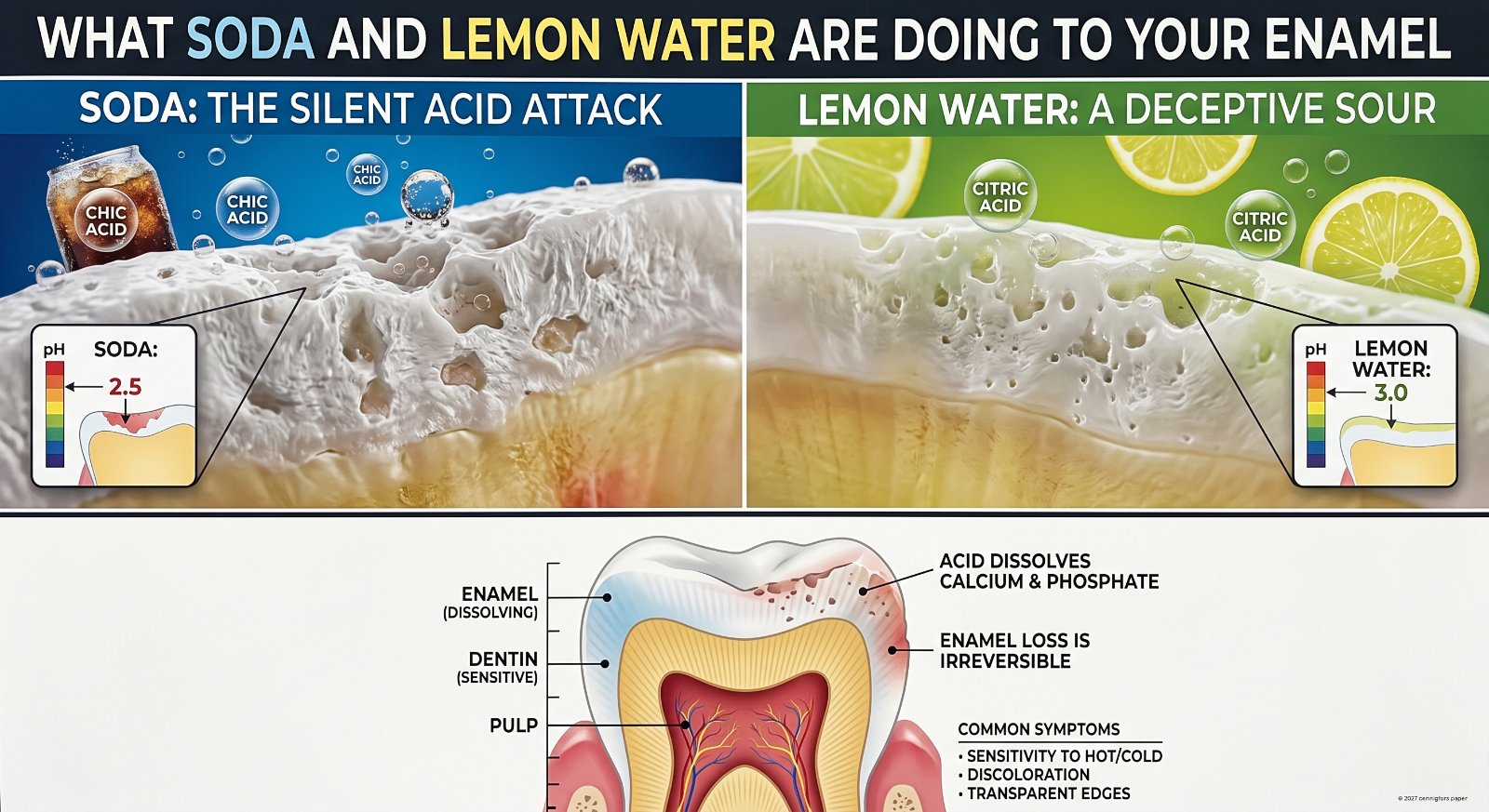
Most dental damage announces itself. A cavity becomes a hole, a crack causes pain, staining is visible on the surface. Erosion does none of that. It removes enamel evenly, from every tooth at once, so slowly that you adapt to it, and by the time it is obvious a great deal has already gone.
It is also the one form of damage that has nothing to do with how well you brush. You can brush perfectly twice a day and still lose enamel steadily, because the cause is chemical rather than bacterial. In fact, brushing at the wrong moment makes it worse.
What is acid erosion, and how is it different from decay?
They are different processes with different culprits.
Decay is bacterial. Plaque bacteria eat sugar and produce acid in one concentrated spot, usually in a groove or between two teeth, and that spot becomes a cavity. It is localised, it makes a hole, and it is what a filling repairs. That whole picture is at celestialdental.org/cavity-treatment-filling-root-canal-or-extraction.
Erosion is chemical. Acid arriving directly in your mouth from food, drink or your own stomach dissolves the mineral out of enamel across every surface it touches. There is no hole and no bacterium involved. The tooth simply gets thinner, everywhere, at once.
The practical consequence is that erosion cannot be filled, and it is not fixed by cleaning better. Enamel contains no living cells, so once it has dissolved, your body has no mechanism to replace it. This is the one dental tissue that is genuinely gone for good.
What causes it here?
The list is longer than most people expect, and several items on it are things people take up specifically because they think they are healthy.
- Sodas, including the sugar-free ones. This is the biggest single cause we see. The damage comes from the phosphoric and citric acid, not only the sugar, so a diet soda erodes enamel just as effectively as the full-sugar version. It is the frequency that matters most: one soda with a meal is far less harmful than the same soda sipped across three hours of an afternoon
- Lemon water. Warm lemon water in the morning, lemon in a bottle sipped through the day, or lemon taken for weight loss, is one of the most erosive habits available, and it is almost always adopted for health reasons. The people doing it are often the most diligent about their health generally, which is why it stings to be told
- Sugarcane juice and fresh citrus juices, taken often
- Energy and sports drinks, which are strongly acidic and usually drunk slowly during activity, when the mouth is already dry
- Passion fruit, tamarind, tangerines and raw lemons, particularly when sucked or held in the mouth
- Vinegar-based drinks, including apple cider vinegar taken as a daily tonic
- Wine and some flavoured waters
- Long chewing sessions with soda, which combine a dry mouth with continuous acid, see celestialdental.org/dry-mouth-causes-risks-and-what-helps
- Acid reflux and heartburn, where stomach acid reaches the mouth, often at night without you being aware of it. This one is medical rather than dietary
- Repeated vomiting, from any cause, including morning sickness in pregnancy, see celestialdental.org/is-it-safe-to-see-a-dentist-while-pregnant
- Some medicines taken in chewable or effervescent form, or that reduce saliva
Dry mouth makes every item on that list worse, because saliva is what neutralises acid and delivers minerals back to the enamel. Less saliva means the acid sits longer and does more.
How do I know if I have it?
Early erosion is genuinely hard to see, which is why it is usually spotted at a check-up rather than by the patient. The signs, roughly in the order they appear:
- Teeth looking more yellow. This is the commonest first complaint, and it is misread as staining. Enamel is whitish and slightly opaque; the dentine underneath is yellow. As enamel thins, the yellow shows through. People respond by buying whitening products, which do nothing for this and often make sensitivity worse, see celestialdental.org/do-charcoal-baking-soda-and-salt-whiten-teeth
- The edges of the front teeth becoming transparent, so the biting edge looks glassy or grey against the light. This is one of the most reliable early signs
- Sensitivity to cold, sweet and air, spread across many teeth rather than one, see celestialdental.org/teeth-sensitive-to-cold-and-sweet-causes-and-treatment
- Front teeth thinning and chipping at the edges, or looking shorter over the years
- Smooth, shallow, shiny dips on the biting surfaces of back teeth, sometimes with an old filling standing slightly proud of the tooth around it, because the filling material does not dissolve and the tooth around it has
- Teeth looking rounded and losing their crisp shape
- Fillings appearing to fall out more often, when in fact the tooth around them has receded
If your teeth have gone yellower over a few years and whitening toothpaste has changed nothing, erosion is a likelier explanation than staining, and it needs a different response entirely.
Why does brushing straight afterwards make it worse?
Because acid softens enamel temporarily before it fully dissolves, and brushing while it is soft scrubs off the softened layer.
After an acidic drink your enamel is briefly vulnerable. Saliva reverses this over roughly the next hour by neutralising the acid and putting minerals back. Brush inside that window, especially with a firm brush and pressure, and you remove enamel that would otherwise have recovered.
So the rule is: wait about an hour after anything acidic before brushing. Rinse with plain water instead if you want to freshen up. This is a genuinely free improvement, and the general technique that goes with it is at celestialdental.org/am-i-brushing-my-teeth-properly-technique-and-electric-vs-manual.
What can I do to stop it getting worse?
The goal is fewer acid attacks and shorter ones, not necessarily giving anything up entirely.
- Cut the number of separate acid events, not just the volume. One soda with lunch is much less damaging than the same bottle sipped over an afternoon. This is the single most effective change, and it is easier to keep than abstinence
- Drink acidic things quickly rather than slowly, and with a meal rather than between meals
- Use a straw for soda and juice, positioned past the front teeth
- Never swill or hold an acidic drink in your mouth, and do not sip and hold a lemon-water bottle at your desk
- Rinse with plain water immediately afterwards, which is a small, effective habit
- Finish with something neutralising: milk, mala, cheese or plain water
- Chew sugar-free gum afterwards to drive saliva flow, which is the body's own repair mechanism
- Take lemon out of the daily routine. If you want it, have it with a meal, and do not make it an all-day sipping habit
- Use a fluoride toothpaste and spit rather than rinse, so the fluoride stays and hardens what enamel you have
- Use a soft brush and light pressure, since eroded enamel wears fastest under scrubbing
- Treat reflux properly with your doctor if you have heartburn, a sour taste in the morning, or you wake with a burning throat. Dental erosion is sometimes the first sign of reflux nobody has diagnosed
- Do not treat dry mouth as normal, especially if you take regular medication
Can the damage be repaired?
The lost enamel cannot be regrown. What can be done is stop the process and rebuild the shape.
- Fluoride varnish and high-fluoride toothpaste, to harden the remaining enamel and reduce sensitivity. This is the first step in nearly every case
- Sensitivity treatment, including agents applied in the chair and used at home
- Composite bonding, to rebuild thinned or chipped edges and cover exposed dentine. Conservative and repairable, and it is the most common repair for front teeth
- Onlays or crowns, where back teeth have lost significant height, see celestialdental.org/do-i-need-a-dental-crown-signs-types-and-how-long-they-last
- A night guard, because erosion and grinding together are far more destructive than either alone, see celestialdental.org/teeth-grinding-and-jaw-pain-causes-and-treatment
- Monitoring with photographs and models, which is genuinely useful. Erosion is slow, so the only way to know whether it is still active is to compare your teeth against a record from a year or two ago
One important sequencing point: whitening is generally not the answer for eroded teeth, and can make sensitivity considerably worse. If the yellowing is from thin enamel, the fix is rebuilding the tooth, not bleaching it. The realistic picture on whitening is at celestialdental.org/teeth-whitening-in-kenya-how-it-works-safety-and-results.
What about children and teenagers?
Worth flagging, because this is where lifelong damage starts and where the habits are easiest to change.
Sodas, juice boxes and squash drunk through the day, particularly from a bottle carried around, produce erosion in young permanent teeth that have to last another seventy years. A child who drinks water at meals and soda occasionally is in a completely different position from one who sips juice continuously.
The other reason to look early is that erosion in a child can be the first sign of reflux or of an eating disorder, and a dentist sometimes sees the pattern before anyone else does. That observation is made carefully and privately, never as an accusation.
Does insurance or SHA cover erosion treatment?
Fluoride treatment, sensitivity management and fillings to repair damaged teeth are treatment rather than cosmetic work, so they are among the more commonly covered items, though cover varies by insurer, scheme and member category. Crowns and onlays are not covered, which matters where erosion has taken enough height off the back teeth to need rebuilding rather than patching. Anything framed as improving appearance is excluded again. Get the plan and a written estimate first, so you know which parts of it you are paying for.
Celestial Dental accepts SHA for eligible schemes and bills more than 20 private insurers directly, including Jubilee, AAR, Madison, CIC, Britam, APA and Equity Bank Insurance. Send your insurer or SHA scheme name, member category and preferred branch and the team will confirm before your visit. See celestialdental.org/dental-insurance-and-sha-coverage.
Book an enamel check
If your teeth have been getting yellower, if the edges are looking see-through, or if you have a daily lemon water or soda habit, come and have the enamel assessed before more of it goes. Erosion caught early is a conversation about habits. Caught late it is a rebuild.
Celestial Dental Centre has clinics in Kasarani (Nairobi), Kamakis (Ruiru) and Eldoret, open every day from 07:00 to 20:00.
Call or WhatsApp +254 707 535 000 or book online at celestialdental.org. Tell us what you drink and how often, honestly, because the pattern through the day matters far more than the total, and nobody here is going to judge it.